From the Six to the Strip: Assessing Marner’s Play Ahead of the Leafs Reunion
Tonight, the lights of the Las Vegas strip will shine brightly. For the first time since his blockbuster sign-and-trade to Vegas last summer, the former Maple Leafs superstar will line up against the jersey he wore for nine seasons. With both teams riding hot streaks, you can bet the Toronto media will be out in full force. Regardless of the final score, you can count on sensationalist headlines tomorrow. So, what better time is there to do a deep dive on how things are going for Marner in his new hometown?
On the surface level, Marner has posted 47 points in 45 games, so he’s slightly off-pace offensively. He’s joined a new team with a much different coaching philosophy, and his average ice time is down a smidge as well. It’s reasonable to assume he’s taken some time to get up to speed in Bruce Cassidy’s system.
He’s still creating offense at even strength, but has an increased attention to detail in his own end.
Marner has always been a strong even strength outscorer, and that has not changed this season. Vegas is scoring 61% of the 5-on-5 goals with him on the ice this season, and he’s posting 2.69 points per 60 minutes, which is right in line with his prime seasons in Toronto. The real story, however, is an evolution in how Marner is being deployed.
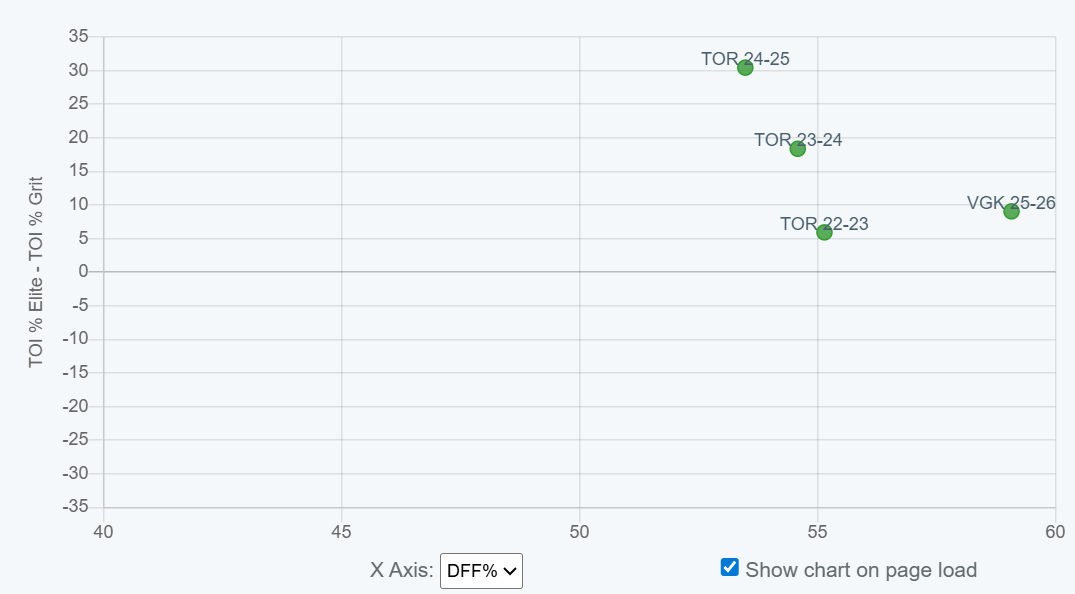
Image sourced from PuckIQ
The graph above shows Marner’s quality of competition and how much his team carries play when he’s on the ice. The higher the dot, the tougher competition he plays (i.e. the opposition’s first line), the more right the dot, the more dominant his team is in terms of generating chances.
Marner is exceptional at even strength. Regardless of competition level, he’s driven play for the majority of his career. This season, however, Cassidy converted him to a center and reduced his level of competition (a benefit of having Jack Eichel on your depth chart), and as a result Marner’s underlying numbers have bloomed. He’s not necessarily generating more offence, but his expected goals against per 60 minutes has dropped to 1.96, about half a goal down from last season. With a bit more stability in goal, Marner could be a sneaky Selke candidate.
The power play is still a work in progress
Vegas has the 4th ranked powerplay in the league, but despite being on the first unit and getting 3:31 of ice time per game, Marner hasn’t quite found his rhythm with the man advantage. He has 3 goals and 14 points this season, which is not bad by any stretch, but still off his career pace. On a per-60 basis, he is at 4.56 points this year, compared to 7.81 points in the 25-26 season, a steep drop-off.
Some of this can be attributed to luck and adjusting to not passing to an elite finisher like Matthews, and if the Golden Knights keep converting at this rate, you have to imagine Marner's PP stats will eventually trend upward.
Conversely the penalty kill has been a revelation
Marner was used heavily as a penalty killer in Toronto, logging 2:00 per game last season under Craig Berube (96th percentile among forwards). Cassidy has cut that workload in half (1:02 per game), and the results are fantastic. Marner’s goals against rate has dropped nearly 50% to 5.18 goals per hour. By using a larger stable of forwards to kill penalties, Vegas keeps their shorthanded units fresh, leading them to have the 8th best PK in the NHL.
While Toronto fans may look at Marner’s production and large cap hit and think they had his best years, Vegas is likely very happy with his contributions this season. Marner has been more efficient, better defensively and is taking on a harder position on the depth chart. He’s stepped back on the PP, but makes up for it on the PK. I don’t think he’ll be in the running to win an Art Ross, but he’s playing a brand of hockey that could help Vegas on a deep playoff run.
Who’s ready for some totally normal takes on the internet tonight?!
